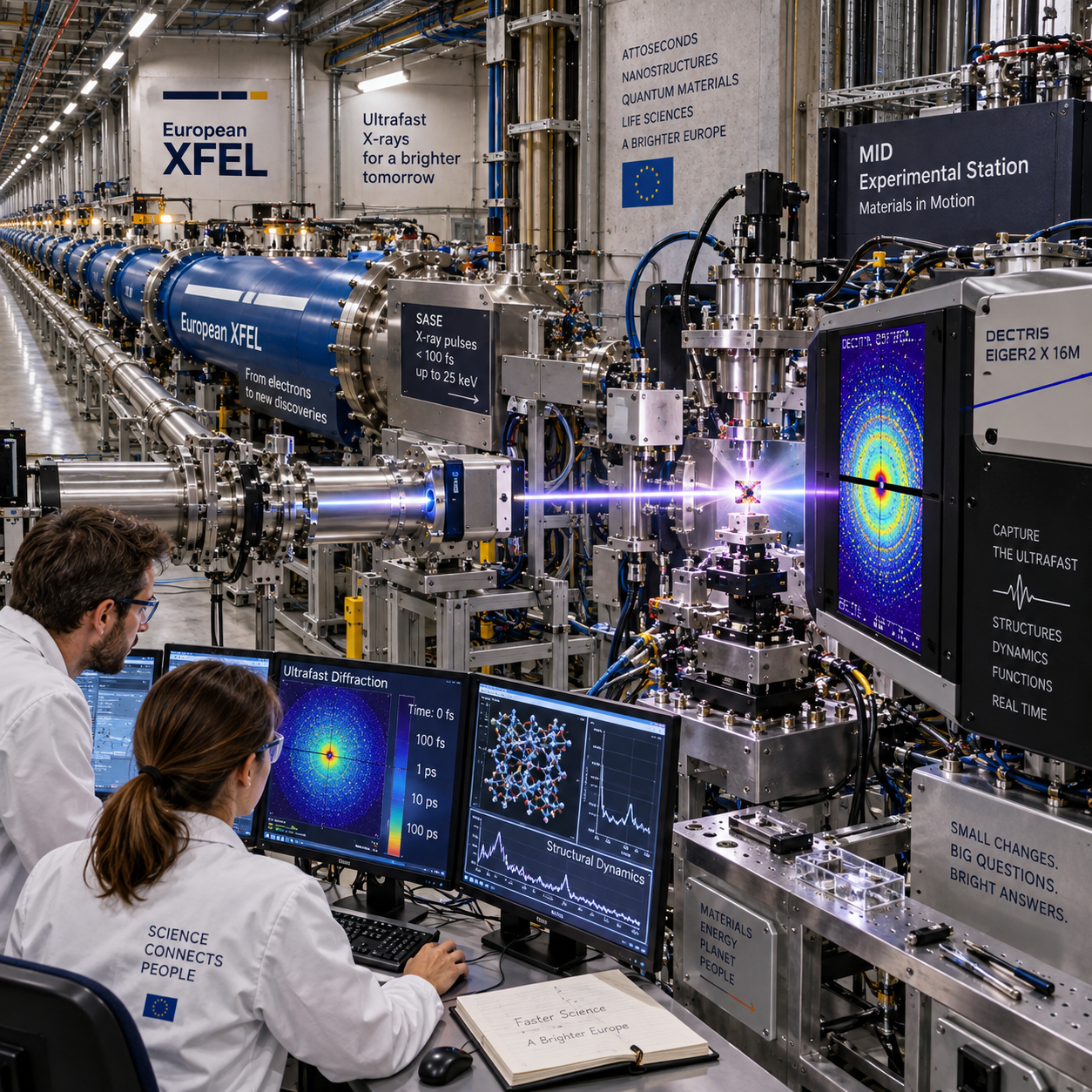

Synchronizing Multiple FELs Across Europe: Technical Challenges and Solutions

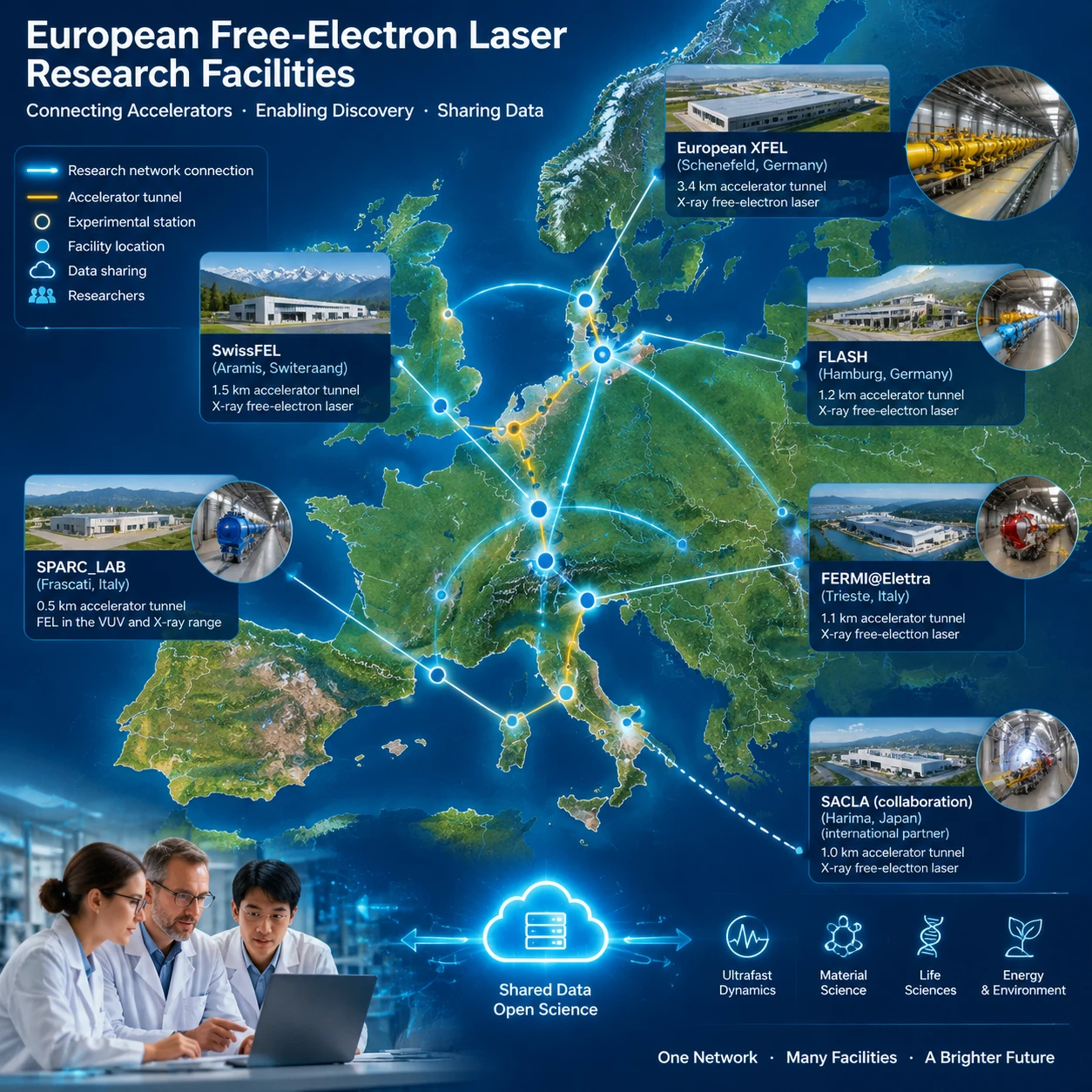
Europe’s free-electron laser (FEL) facilities provide researchers with intense, tunable X-ray and other light pulses for experiments that reveal how matter changes at very short timescales. Coordinating these facilities can make access and collaboration more effective, but it does not mean operating separate accelerators as one machine. The practical goal is to align information, processes and user support while preserving each facility’s distinct capabilities and operating constraints.
Why coordinate Europe’s FEL facilities?
Coordinating Europe’s FEL facilities helps researchers find suitable experimental capabilities, plan access and share expertise across institutions. It can also improve how public research infrastructure is used, while each facility continues to operate independently.
A scientific question may need a particular photon energy, pulse structure, sample environment or detector. No single facility can be assumed to provide every combination. Better coordination can help researchers compare options early and identify whether one experiment, a sequence of experiments, or a collaboration between groups is realistic.
The value is especially clear for projects that need complementary measurements. A team might use one FEL to capture ultrafast dynamics and another facility to investigate a related energy range or experimental condition. Such plans require more than compatible instruments: the researchers must account for different proposal cycles, sample requirements, data policies and operating schedules.
Coordination can also strengthen research collaboration. Facility scientists and instrument teams may share technical experience, refine experimental methods and help users avoid repeating development work. The trade-off is that coordination takes staff time and can add administrative steps. It is worthwhile when shared planning improves scientific outcomes or reduces avoidable friction, not as an end in itself.
What synchronization means in practice
Synchronizing FELs in practice means coordinating operational information, user processes and research workflows, not phase-locking or merging separate accelerators. Each facility retains its own accelerator, instruments, safety rules and control systems.
The term covers three connected layers:
- Operational coordination: sharing accurate information about facility availability, maintenance periods, commissioning and expected operating modes.
- Technical interoperability: making instruments, controls and data easier to describe, connect or compare across sites where useful.
- User-facing coordination: helping researchers understand proposal routes, access requirements, experiment planning and data-handling expectations.
These layers should not be confused. A shared data description does not guarantee that two beamlines can run the same experiment, and a coordinated calendar does not make accelerator operations interchangeable. The most realistic approach is to standardize what benefits users, while documenting facility-specific differences clearly.
For a researcher, useful synchronization might mean being able to compare instrument capabilities and proposal deadlines before committing to a multi-site study. For facility teams, it can mean exchanging timely operational updates through agreed channels. The measure of success is whether the coordination supports sound experimental decisions without creating a false impression that facilities are technically identical.
Technical challenges across facilities
Technical interoperability is difficult because European FEL facilities differ in accelerator design, photon delivery, experimental instruments, control systems, data formats and operating procedures. These differences affect how experiments are prepared, run and interpreted.
Accelerators, instruments and controls
Accelerator operations determine which beam conditions are available, and different facilities may offer distinct pulse patterns, photon-energy ranges or stability characteristics. Experimental instruments add another layer: detectors, sample environments, timing diagnostics and calibration methods can vary even when two facilities address similar science.
Control systems also differ in their software, interfaces, naming conventions and methods for recording machine and instrument state. A control sequence developed at one site may need substantial adaptation elsewhere. Sharing code can save effort, but it needs testing against local hardware, safety systems and support practices before it is used in an experiment.
Data management and interoperability
Combining results from different facilities requires more than placing files in one repository. Data may use different formats, metadata fields, units, calibration records and conventions for describing samples or experimental conditions. If the run conditions are missing or recorded differently, researchers may struggle to reproduce an analysis or make a valid comparison.
A practical interoperability effort should prioritize common descriptions for key information, such as instrument configuration, photon conditions, detector settings, sample identity and processing steps. Facilities can preserve their local systems while improving export formats, metadata documentation and access to analysis tools. The limitation is real: translating between formats cannot recover information that was never recorded, and a common format alone does not make measurements scientifically equivalent.
For planning a cross-facility experiment, teams should identify the data and metadata needed for comparison before collecting samples. Agreeing on units, calibration references and analysis responsibilities early is usually easier than trying to reconcile them after beamtime.
Scheduling beamtime and coordinating users
Coordinating beamtime means aligning proposal decisions, facility availability, experiment requirements and researcher access across separate scheduling systems. It does not guarantee that facilities can offer matching dates or equivalent operating conditions.
Beamtime allocation is shaped by peer review, scientific priority, instrument readiness, maintenance and accelerator operations. Each facility may set its own proposal deadlines, review process, safety requirements and user-support arrangements. A project that depends on sequential measurements therefore needs a schedule with room for slippage, rather than assuming that acceptance at one site secures a slot at another.
Researchers can reduce planning risk with a simple sequence:
- Define dependencies: identify which measurement must happen first and what results or samples the next experiment requires.
- Compare capabilities: check photon conditions, instrument configuration, sample limits, detector access and technical support with facility contacts.
- Map the access process: record proposal deadlines, review periods, user registration and safety training requirements for every site.
- Build contingency into the science plan: decide which measurements remain useful if schedules shift or a particular operating mode is unavailable.
User access also involves travel, sample transport, data permissions and continuity between on-site and remote work. Clear points of contact help researchers navigate those details. A shared overview of opportunities could make options easier to compare, but it cannot replace each facility’s formal proposal and allocation process.
Solutions for interoperability and collaboration
Interoperability improves when facilities agree on practical shared protocols, document local differences and coordinate planning around specific scientific needs. The aim is compatibility where it helps, not uniformity for its own sake.
Useful approaches include common terminology for describing instrument capabilities, machine-readable metadata for essential experimental conditions and documented ways to export or exchange data. Control-system teams can identify reusable software components, while keeping facility-specific drivers and safety controls under local responsibility. Researchers benefit when proposal guidance explains how to describe a multi-facility project and where to ask technical questions.
Coordination works best as a continuing conversation among accelerator operators, instrument scientists, data specialists, user offices and research groups. A small cross-facility planning team can map one specific workflow, such as repeating a measurement under different photon conditions. That exercise can reveal which information needs a common definition and which differences must remain explicit.
Shared standards carry costs. They require maintenance, version control and decisions about who supports tools when systems change. Over-standardizing can also constrain a facility’s ability to develop an instrument for a specialized experiment. A sensible rule is to standardize the interfaces and metadata that enable exchange, while allowing local implementation to evolve.
Building a resilient European FEL network
A resilient European FEL network depends on sustained governance, transparent communication and coordination that can adapt as scientific priorities and facility capabilities change. No single agreement or technical platform can substitute for regular work between participating institutions.
Governance should clarify who maintains shared descriptions, updates operational information and handles user questions that cross institutional boundaries. Responsibilities need to be specific enough that researchers know where to turn, but flexible enough to accommodate each facility’s allocation rules and national context.
Progress can be assessed with practical indicators: whether users can compare capabilities accurately, whether operational changes reach affected teams in time, and whether cross-facility datasets retain the metadata needed for analysis. Periodic reviews with researchers can expose gaps that technical teams may miss, especially around sample logistics and the transition from beamtime to data analysis.
Coordination should grow from demonstrated needs. Start with a defined research workflow, identify the information and services that would make it easier, then test the approach with facility and user teams. That measured process protects scientific flexibility while making Europe’s distributed FEL infrastructure easier to navigate and more effective for collaborative research.
Frequently asked questions
Does synchronizing FELs mean operating them as one machine?
No. European FEL facilities remain separate accelerators with their own instruments, controls and operating schedules. Synchronization refers to coordination of information, access and workflows.
What makes data from different FEL facilities difficult to combine?
Facilities may record measurements with different formats, metadata, units, calibration methods and instrument descriptions. Researchers need enough shared context to compare results; file conversion alone cannot resolve missing or incompatible experimental information.
How can researchers access multiple European FEL facilities?
Researchers should review each facility’s capabilities and formal proposal process, then contact the relevant user office or instrument team about feasibility, deadlines, safety and sample requirements. Access is assessed through each facility’s own procedures.
Who coordinates beamtime and operational planning?
Facility teams coordinate their own beamtime allocation and accelerator operations. Cross-facility planning may involve user offices, instrument scientists, accelerator staff and research teams, depending on the project and any established collaboration arrangements.