

Data Management Strategies for Petabyte-Scale FEL Experiments
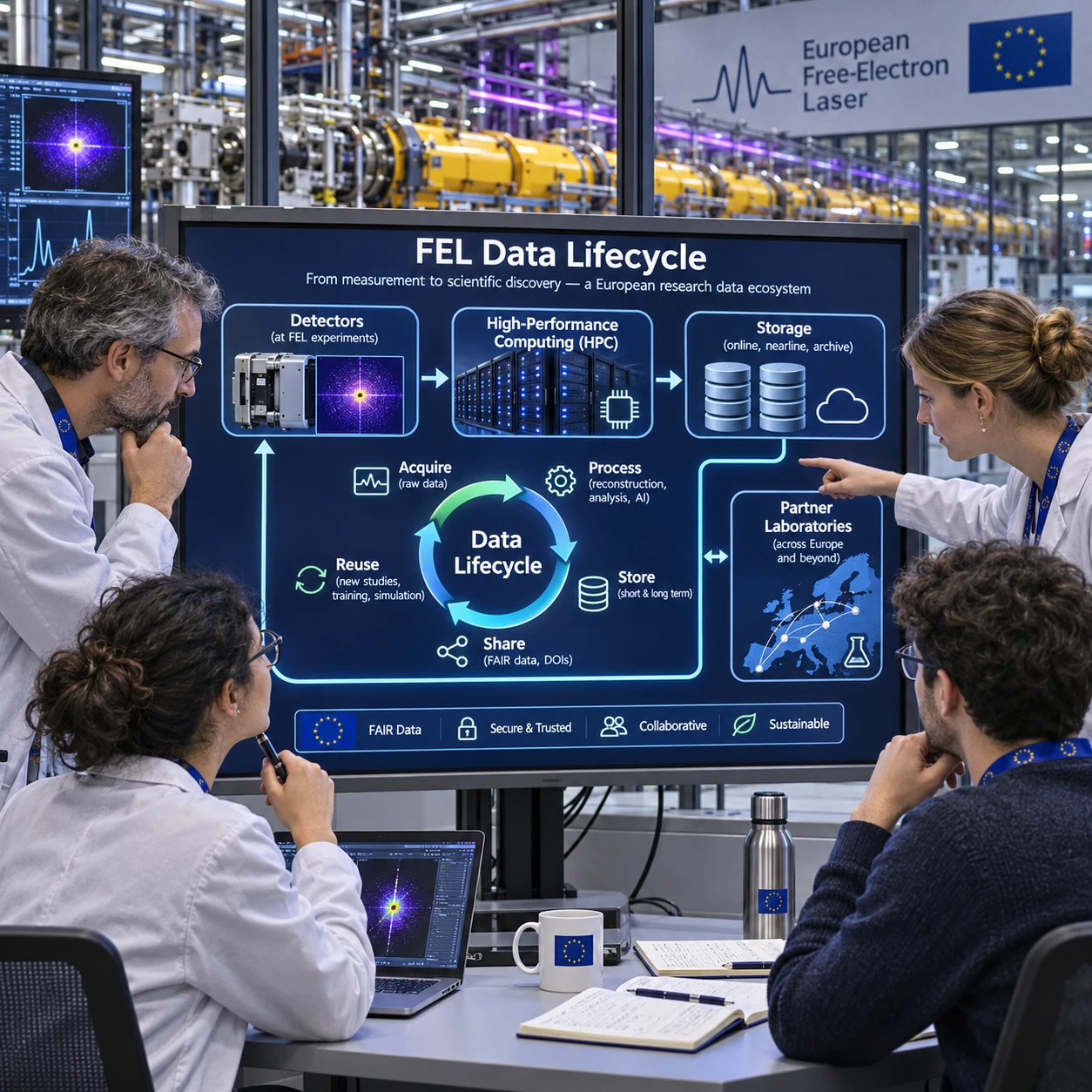
Petabyte-scale free-electron laser (FEL) experiments put pressure on every stage of research data management. Detectors can generate data faster than teams can inspect it, while analysis may need to begin during an experiment and results must remain interpretable years later. A robust strategy coordinates acquisition, networks, computing, storage, metadata, people, and policy as one experimental workflow.
Why FEL Experiments Create Distinctive Data Challenges
FEL experiments create distinctive data challenges because they combine high-rate acquisition, complex instrument configurations, and tight analysis deadlines. Facilities must capture valuable measurements reliably while giving researchers timely access to useful data.
Data acquisition systems may collect many detector streams alongside timing, machine, sample, and environmental information. The total volume and arrival pattern depend on the experiment, detector configuration, and operating conditions, so a petabyte-scale plan cannot be based on a single average-rate estimate. Short bursts can matter as much as daily totals: the network and storage must cope with peak traffic, not just the average.
There is also a decision problem. Scientists may need early quality checks to adjust an experiment, but the raw data can be too large to review manually or send immediately to every collaborator. Some data can be filtered or reduced for rapid feedback; other measurements need to be retained in their original form for later analysis. That choice affects scientific value and must be agreed with instrument scientists and users, not left to an automated cleanup rule.
FEL data management is therefore a lifecycle and coordination challenge. Acquisition, high-speed data transfer, high-performance computing (HPC), storage, and analysis teams need a shared view of what is being captured, where it goes, and who is responsible at each handoff.
Design the Data Workflow Around the Experiment
Design the FEL data workflow as a planned path from acquisition to retention, with checkpoints for quality, ownership, and access. Mapping that path before beam time helps uncover bottlenecks while there is still time to change the setup.
Start with an experiment-specific data plan. Estimate the amount and rate of raw data, expected processed outputs, likely analysis demand, and retention requirements. Record which data are essential, which can be regenerated, and which may be reduced or discarded under an approved policy. Estimates should include calibration and diagnostic files, not only the headline detector output.
Then map the handoffs:
- Acquire: Capture detector data and the context required to interpret it, including configuration and run identifiers.
- Validate: Check that files are complete, readable, and associated with the correct run before downstream processing.
- Process: Send suitable data to local compute or HPC for calibration, reduction, and analysis.
- Store and share: Provide working access to active datasets and communicate status to the experiment team.
- Preserve: Retain selected raw data, derived results, metadata, and documentation according to facility and project policy.
Assign an owner to every transition. If acquisition completes but transfer status is unclear, or a pipeline produces output without recording its software version, scientists lose time reconstructing what happened. A workflow diagram and a named contact for each system are practical controls, not paperwork for its own sake.
Match Storage and Compute to Data Needs
Match storage and compute to how often data are used, how quickly they are needed, and whether they can be recreated. Tiered storage can control cost and improve access, but only if movement between tiers is visible and predictable.
Facilities commonly distinguish three broad data states. Active data support acquisition and near-term analysis, so they need fast access and sufficient capacity for concurrent work. Processed data include calibrated or reduced outputs used by researchers; they may be smaller than raw data but still need clear links to their inputs. Archive data are retained for longer-term preservation and may have different access times and operational costs.
These are policy categories, not a mandate for a particular storage technology. A facility might use disk, tape, or a combination, depending on its workload, staffing, access expectations, and resilience requirements. Choosing lower-cost archival storage means accepting that retrieval may take longer; keeping everything on the fastest tier means paying for capacity that may rarely be used. Communicate these trade-offs before the experiment, especially if a collaboration expects remote access to large datasets.
Coordinate storage with HPC scheduling. A pipeline that can access compute nodes but cannot efficiently read the required files will not meet analysis needs. Conversely, reserving substantial compute capacity is wasteful if data are still transferring or waiting for validation. Plan the sequence of data arrival, staging, job execution, and output placement, and monitor whether shared systems have enough capacity for overlapping experiments.
Build Reliable Data Movement and Processing Pipelines
Reliable data movement and processing require capacity planning, automated checks, visible monitoring, and recovery procedures. The right combination depends on each facility’s network, instruments, compute environment, and collaboration model.
Plan high-speed data transfer using measured or expected peak rates, file sizes, and competing traffic. Test the entire route from acquisition to processing or partner access, rather than assuming that a fast link guarantees a fast end-to-end workflow. Small files, protocol overhead, congestion, and destination write performance can all limit throughput.
Automated pipeline checks should confirm that expected files arrived, checksums match where used, formats can be read, and outputs are associated with the correct run. A failed check should generate an actionable alert, not silently leave a partial dataset available for analysis. Pipeline monitoring should expose queue delays, transfer status, processing failures, and storage pressure to the people who can respond.
Design for interruption. Resumable transfers, retry policies, temporary staging, and documented recovery steps can reduce the impact of network or service failures. Avoid treating one copy as a backup simply because it sits in a different directory. Recovery planning should identify which copy is authoritative, how integrity is checked, and who can restore data.
Automation also needs limits. A pipeline that automatically deletes intermediate files may save space but can remove evidence needed to diagnose a processing error. Define retention and cleanup rules explicitly, preserve logs and software versions, and test changes on representative data before relying on them during beam time.
Make Data Findable, Interpretable, and Reusable
To make FEL data findable, interpretable, and reusable, connect each dataset to consistent metadata, documentation, provenance, and access rules. FAIR data principles provide a useful framework, but FAIR implementation must reflect scientific context and legitimate access restrictions.
Metadata should let a researcher answer basic questions without opening every file: which experiment and run produced this dataset, what instrument configuration was used, what processing has occurred, and where are the associated outputs? Use stable identifiers and a data catalogue that can index datasets across relevant storage locations. A catalogue is especially valuable when data move between active storage and archive, because their physical location may change while their identity should not.
Preserve provenance: record processing steps, software and version information, parameters, and the relationship between raw inputs and derived results. Add a concise readme or equivalent documentation describing file formats, units, naming conventions, and known limitations. If instrument settings are stored in separate systems, document how to retrieve or link them.
FAIR does not mean that every dataset must be openly available immediately. Proposal terms, privacy, intellectual property, embargoes, and facility policies may restrict access. Apply permissions deliberately, document who can access data and when, and make the route for requesting access clear. The goal is to make data findable and usable by authorized researchers, while preserving the conditions under which they were collected.
Coordinate Across Facilities and Research Teams
European FEL research benefits when facilities and research teams agree on shared ways to describe, exchange, and cite data, while allowing for local infrastructure and policy differences. Interoperability depends on clear interfaces and governance, not on every site adopting identical systems.
Before a cross-facility project begins, agree on identifiers, metadata fields, file-format expectations, transfer responsibilities, and access procedures. Define which facility is authoritative for each record and how partners will report corrections or missing context. A common minimum metadata set can make datasets easier to discover without forcing instruments with different capabilities into an artificial template.
Collaboration also needs operational agreements. Specify who pays for transfer and storage, how long partner access lasts, whether derived products can be redistributed, and who handles incidents. Large transfers may require scheduling or staged access; researchers should know the expected route and limitations before analysis depends on remote files.
Shared standards should be reviewed with data stewards, instrument scientists, computing teams, and users. Too little standardization makes exchange fragile. Too much can create burdensome fields that teams fill inconsistently. Keep mandatory metadata focused on information needed for interpretation, discovery, and responsible management, then allow facility-specific extensions.
Turn Strategy into an Operational Plan
Turn a data-management strategy into an operational plan by assigning responsibilities, testing the workflow, and reviewing real performance after experiments. A plan is useful only when the people, policies, and infrastructure can carry it out.
For each experiment, identify a data contact and confirm the responsibilities of acquisition, network, HPC, storage, and scientific teams. Document expected data rates and volumes, quality checks, processing priorities, access rules, retention decisions, and escalation contacts. Where estimates are uncertain, state the assumptions and establish a checkpoint to revise them as measurements become available.
Use rehearsals or smaller test runs to expose practical failures: a metadata field that is not populated, a destination with insufficient write performance, or an alert that reaches nobody on shift. After the experiment, compare planned and observed transfer and processing behavior, review failed jobs and recovery actions, and capture changes for the next run.
Measure what helps teams make decisions: completeness of required metadata, time from acquisition to usable results, pipeline failure and recovery patterns, archive retrieval experience, and unresolved access requests. These indicators should guide improvement, not become targets that encourage premature deletion or rushed processing. Petabyte-scale FEL data management succeeds when each stage is reliable, responsibilities are clear, and scientific context survives the journey from detector to future reuse.